
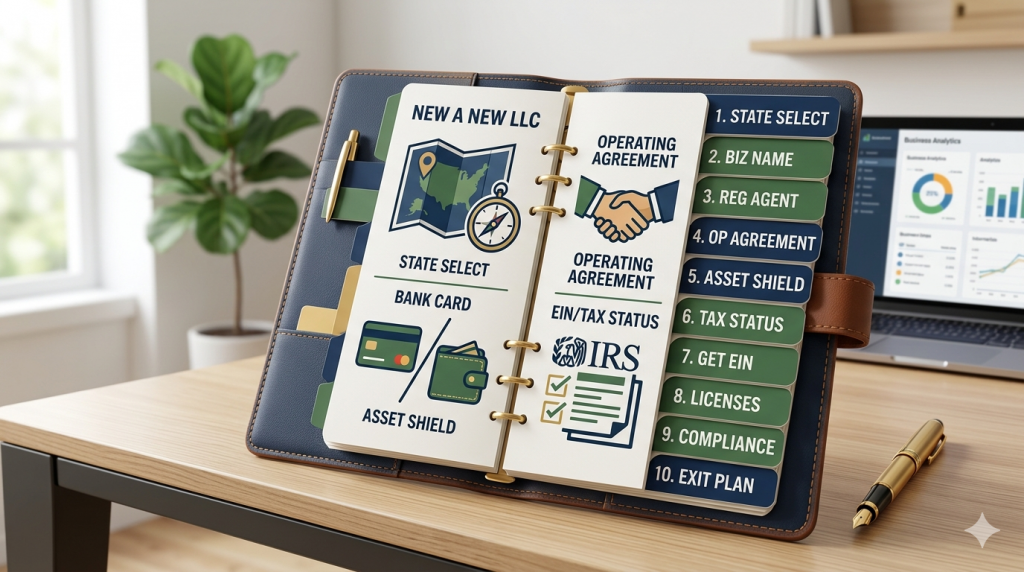
Forming a Limited Liability Company (LLC) is an exciting milestone. It bridges the gap between a casual side hustle and a fully protected, official business. While the process is simpler than setting up a major corporation, it isn’t quite as hands-off as a sole proprietorship.
At Mull Bookkeeping, we help small businesses keep an average of $7,200 more in profit every year by streamlining their finances. We know that the choices you make during the formation stage heavily impact your profitability, time management, and tax liabilities down the road.
If you’re launching a new LLC, jumping in without a clear financial and legal roadmap can lead to expensive headaches later. Keep these ten critical foundational steps in mind to get your business off to a smooth start.
1. Choosing the Right State to Register
Most small business owners assume they should register where they live—and usually, they’re right. Registering in your home state is generally the most cost-effective approach.
If you register in a historically “business-friendly” state like Delaware or Nevada but operate entirely out of your home state, you will likely have to pay fees in both jurisdictions. You’ll register as a domestic LLC in the entity state and a foreign LLC in your home state, doubling your paperwork and annual filing fees.
2. The Nuances of Your Business Name
Your business name needs to do more than just sound good on a business card; it has to meet strict legal requirements:
- It must include an official designator like “LLC” or “Limited Liability Company.”
- It cannot include misleading words (e.g., using “Bank” or “Insurance” without proper licensing).
- It must be entirely unique within your state’s database.
Pro Tip: Before filing, check the U.S. Patent and Trademark Office (USPTO) database. Just because a name is available with your Secretary of State doesn’t mean it isn’t already trademarked nationally by someone else.
3. Appointing a Reliable Registered Agent
States require LLCs to name a Registered Agent—a designated individual or entity available during normal business hours to accept formal legal documents and government notices on your company’s behalf.
While you can act as your own registered agent, your physical address will become a matter of public record. Many business owners hire a professional registered agent service to maintain their privacy and ensure they don’t miss time-sensitive legal notices.
4. Drafting an Operating Agreement (Even if You are a Solo Owner)
An Operating Agreement outlines who owns what percentage of the LLC, how profits and losses are handled, and what happens if a member wants to leave.
If you are a single-member LLC, you might think you don’t need one since you aren’t going to argue with yourself. However, banks, investors, and courts often ask to see this document. Having one in writing reinforces your “corporate veil”—the legal separation that protects your personal assets from your business liabilities.
5. Keeping Your Assets Distinct (The Bookkeeping Golden Rule)
The primary reason to form an LLC is to protect your personal assets (your home, savings, and car) from business debts and lawsuits. But that protection isn’t automatic. If you mix personal and business funds, a court can rule that your LLC is an illusion and strip away your liability protection—a legal concept known as “piercing the corporate veil.”
[Personal Wallet] <--- DO NOT MIX ---> [LLC Bank Account]
To maintain a secure liability shield and ensure clean financial reporting, adhere to these operational practices from day one:
- Open a dedicated business checking account immediately after forming.
- Never use personal credit cards for business expenses (and vice versa).
- Sign all business contracts using your official title (e.g., “Jane Doe, Managing Member” instead of just “Jane Doe”).
6. Deciding How You Want to Be Taxed
By default, the IRS views a single-member LLC as a “disregarded entity” (taxed like a sole proprietorship) and a multi-member LLC as a partnership. This means profits pass directly to your personal tax return, and you’ll pay regular income tax plus self-employment taxes.
However, an LLC gives you the flexibility to elect S-Corporation or C-Corporation tax status if your profits reach a certain threshold. An S-Corp election can dramatically reduce your self-employment tax liability, but it also requires setting up formal payroll. This election alters your tax structure significantly, so consulting an accounting professional early on is highly recommended.
7. Getting Your Federal Employer Identification Number (EIN)
Think of an EIN as a Social Security Number for your business. You will need it to open a business bank account, hire employees, and manage federal taxes. You can get an EIN online directly from the IRS website for free in about ten minutes. Avoid third-party websites that try to charge you a fee for this process.
8. Locating Local Licenses and Permits
Filing your Articles of Organization with the state does not automatically mean you have permission to start selling. Depending on your industry and location, you may also need:
- A general local business license from your city or county.
- A state sales tax permit (seller’s permit) if you sell tangible goods.
- Specialized professional licenses (e.g., for construction, real estate, or health services).
9. Navigating Ongoing State Compliance Calendars
Forming an LLC isn’t a one-time transaction. To keep your business in good standing, you must maintain ongoing requirements. Most states demand an Annual Report or Biennial Report, alongside a state fee or franchise tax.
| Requirement | What It Involves | Consequence of Failure |
| Annual/Biennial Reports | Updating the state on your current address and management structure. | Late fees, interest, or administrative dissolution. |
| Franchise/State Taxes | Paying flat fees or tax percentages required to operate in that state. | Loss of “Good Standing” status, hindering your ability to secure financing. |
10. Implementing an Accurate Financial System Early
Many new business owners fail to properly record all of their expenses, meaning they miss out on massive write-offs and end up paying too much in taxes. Setting up an organized bookkeeping system on day one ensures you render unto Caesar that which is Caesar’s—but not a penny more! Clean books give you the financial data you need to analyze your projects, focus on profitability, and scale with confidence.
Let Us Handle the Numbers So You Can Build Your Business
Building a solid foundation for your LLC takes a bit of time upfront, but it pays off by protecting your personal finances. At Mull Bookkeeping, led by Charles Mull—an Intuit ProAdvisor with over 10 years of accounting experience—we eliminate the stress of tracking transactions. We provide personalized, affordable financial management solutions so you can focus on what you do best: serving your customers.