
Real estate investing is one of the most powerful wealth-building engines in the world. But whether you manage a single fix-and-flip, a small portfolio of long-term residential rentals, or a sprawling commercial empire, your success doesn’t actually happen in the market.
It happens in your books.
Many investors treat bookkeeping as an afterthought—something to scrambled-together in a panic every April. But successful, scaling investors know that clean financial tracking is the ultimate secret weapon for maximizing deductions, securing funding, and staying ahead of the taxman.
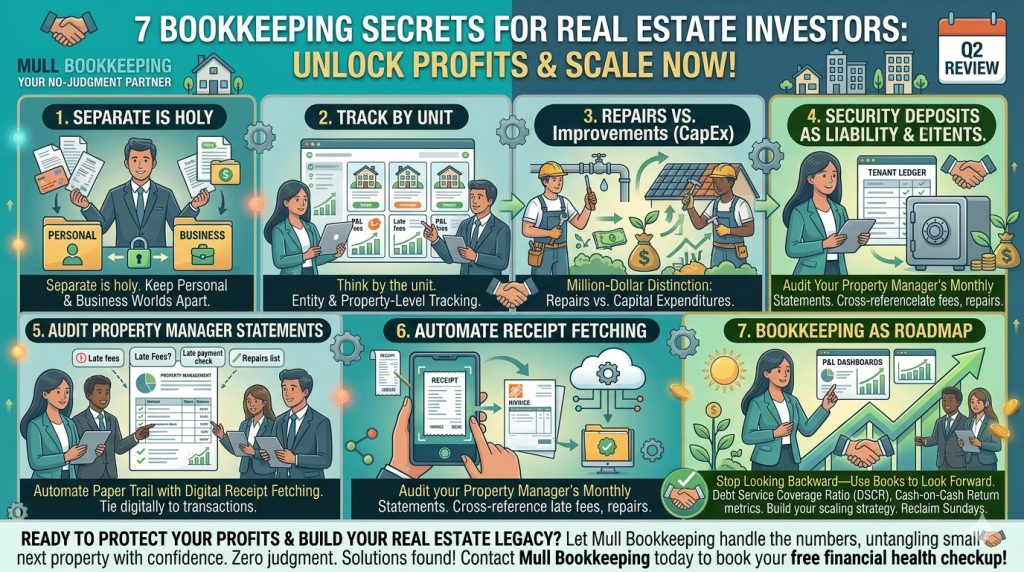
At Mull Bookkeeping, we pull back the curtain for real estate professionals every day. Here are seven bookkeeping secrets that will protect your profits and help you scale your portfolio confidently.
1. Separate Is Holy: Keep Personal and Business Worlds Apart
The fastest way to trigger an IRS audit—and give your bookkeeper a headache—is “commingling” funds.
Never buy groceries with your property management card, and never pay a roofing contractor from your personal checking account. Even if you operate as a sole proprietorship without a formal LLC, establish a dedicated business checking account and credit card for your real estate activities from day one. It creates a clean paper trail, protects your personal liability, and saves you dozens of hours of forensic accounting at year-end.
2. Think by the Unit: Implement Entity and Property-Level Tracking
If you own three properties and lump all your rental income and repair expenses into one giant spreadsheet category called “Real Estate,” you are flying blind.
You need to know exactly which asset is performing and which one is bleeding cash. Implement a bookkeeping system that utilizes Class Tracking or Job Costing. This allows you to tag every single dollar of income and expense to a specific property or unit. You’ll instantly see which property has an unnaturally high maintenance overhead and which one is your true cash cow.
3. The Million-Dollar Distinction: Capital Expenditures vs. Repairs
How you categorize a property expense changes everything at tax time. Mistakenly swapping a Repair for a Capital Expenditure (CapEx) can cost you thousands in unexpected taxable income.
- Repairs & Maintenance: Routine fixes that keep the property in its normal, efficient operating condition (e.g., fixing a leaky pipe, patching a wall, fixing a broken window). These are fully deductible in the year you pay for them.
- CapEx (Improvements): Upgrades that add significant value, prolong the property’s life, or adapt it to a new use (e.g., replacing the entire roof, installing a new HVAC system, a complete kitchen remodel). These must be capitalized and depreciated over several years.
Knowing how to classify these accurately keeps your cash flow projections realistic and ensures your tax returns are legally optimized.
4. Track Your Tenant Security Deposits as a Liability (Not Income)
When a tenant hands you a first month’s rent and a security deposit, it feels like a big win for your bank account. However, that security deposit is not your money.
Legally and financially, a security deposit is a liability—a temporary loan from the tenant that you must hold in trust. It belongs on your Balance Sheet as a liability, not on your Profit & Loss statement as revenue. Counting deposits as income artificially inflates your profits and can result in you paying taxes on money you eventually have to give back.
5. Audit Your Property Manager’s Monthly Statements
If you use a third-party property management company, don’t just glance at the net direct-deposit they send you every month and assume all is well.
Property managers are human, and their software can make mistakes. Every single month, you or your bookkeeper should cross-reference their statements against your bank records. Are they accurately charging late fees? Did they overcharge for a maintenance call? Are their management fees aligned with your contract? Treat their statement like an invoice that needs careful verification.
6. Automate the Paper Trail with Digital Receipt Fetching
Real estate investing involves an avalanche of paper: Home Depot runs, contractor invoices, closing disclosures (HUD-1 statements), and insurance policies. If you keep these in a shoebox or your truck’s glove compartment, they will disappear, taking your tax write-offs with them.
Use digital receipt-catching tools (like Dext, Hubdoc, or integrated software features) to snap photos of receipts the moment you get them. Tie them digitally to the corresponding bank transaction. If the IRS ever knocks on your door, you won’t be digging through boxes; you’ll click a button and show them an airtight digital archive.
7. Stop Looking Backward—Use Books to Look Forward
The biggest secret of all? Bookkeeping isn’t a historical archive; it’s a strategic roadmap.
When your books are updated weekly or monthly by a professional, you don’t just look at what you spent last quarter. You can actively track your Debt Service Coverage Ratio (DSCR), watch your cash-on-cash return metrics fluctuate, and know exactly when you have accumulated enough clean capital to confidently pull the trigger on your next acquisition.
Don’t Let the Numbers Hold Your Portfolio Back
You got into real estate investing to build wealth, achieve freedom, and construct a legacy—not to become a data-entry clerk chained to financial software.
If your books are currently a mountain of unorganized receipts, un-reconciled bank loops, or confusing spreadsheets, let Mull Bookkeeping take the burden off your shoulders. We specialize in untangling small business and investor finances, giving you the crystal-clear clarity you need to buy your next property with confidence.
👉 Ready to treat your real estate portfolio like the elite business it is? Contact Mull Bookkeeping today to book your free financial health checkup!